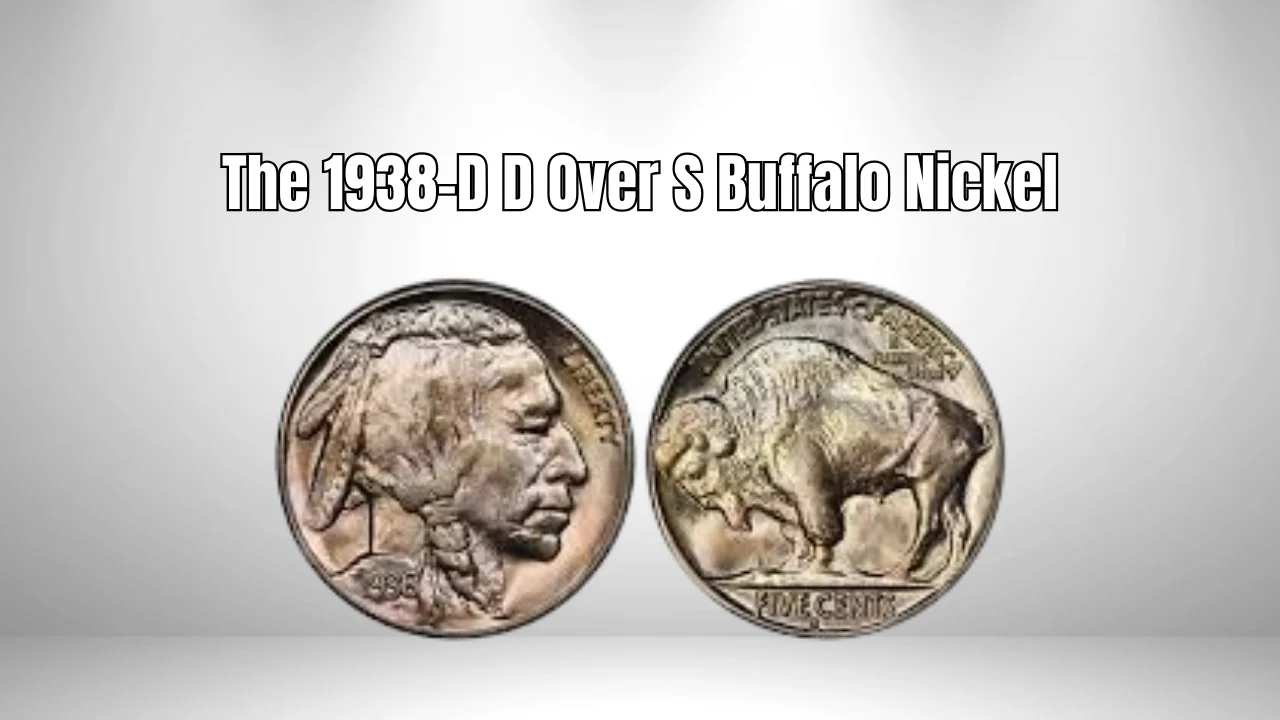
The 1938-D D Over S Buffalo Nickel: If you are a coin collector or just someone who finds old coins interesting, the 1938-D D Over S Buffalo Nickel is a piece you will want to know about. It is not just another coin from the past. It is a mistake-turned-treasure that marks the end of the iconic Buffalo Nickel series and showcases a quirky minting anomaly that continues to intrigue numismatists to this day.
In this article, we will dive into the story of the 1938-D D Over S Buffalo Nickel, how it came to be, what makes it unique, and why collectors love it. From how the over-mintmark happened to how grading companies handle it, this guide will help you understand its value, its background, and how to identify it in your own collection. Whether you are a beginner in coin collecting or someone who wants to expand your knowledge, this breakdown will help you appreciate why this nickel is such a standout.
The 1938-D D Over S Buffalo Nickel
The 1938-D D Over S Buffalo Nickel is one of those rare coin varieties that tell a bigger story about how things used to work at the U.S. Mint. Back in 1938, when Buffalo Nickels were being phased out to make way for the new Jefferson design, the Mint had to act fast. They had reverse dies prepared for San Francisco production, but then plans changed. Instead of throwing those dies away, they punched a Denver “D” over the already present San Francisco “S” and used them in Denver. That is how the over-mintmark, also known as OMM, came to exist.
This minting decision created a final-year coin with a twist, and that twist has made the 1938-D D Over S Buffalo Nickel one of the most collectible nickels in U.S. history. With a visible D over S mintmark and clear die markers, especially in stronger varieties, this coin has become a favorite among Buffalo Nickel collectors. Add in the fact that it was minted during a key transition in U.S. coinage history, and it is easy to see why this variety is so respected.
Overview Table: 1938-D D Over S Buffalo Nickel at a Glance
| Feature | Details |
| Coin Type | Buffalo Nickel |
| Year of Issue | 1938 |
| Mintmarks Involved | Denver (D) over San Francisco (S) |
| Reason for Over-Mintmark | Reused San Francisco dies punched with a Denver mintmark |
| Known Reverse Dies | At least three, with varying levels of visibility |
| Strongest Variety | Features a clearly tripled D with visible S underneath |
| PCGS Designation | Only strongest D/S variety is recognized officially |
| NGC Designation | Recognizes multiple weaker varieties like OMM-1 to OMM-4 |
| Market Availability | Fairly available due to collector roll saving in 1938 |
| Collector Interest | High, especially for strongest mintmark version |
Why It’s an Over-Mintmark, Not an Overdate
To really understand the 1938-D D Over S Buffalo Nickel, it is important to get the terminology right. Many collectors are familiar with overdates, where one year is stamped over another. That is not the case here. The date on this nickel is untouched. The variety is called an over-mintmark because a Denver “D” was punched over a San Francisco “S”.
In the 1930s, mintmarks were still punched into dies by hand. This meant mistakes were not uncommon. But what makes this coin unusual is that only Denver minted Buffalo Nickels in 1938. The presence of a San Francisco “S” under the “D” is a clue that dies meant for one mint were reused at another. This is what makes this variety both curious and valuable.
How the D Over S Occurred
The origin of the 1938-D D Over S Buffalo Nickel comes down to efficiency and timing. Early in 1938, the U.S. Mint had reverse dies set up for the San Francisco Mint. But plans changed, and San Francisco did not produce Buffalo Nickels that year. Instead of wasting the prepared dies, the Mint decided to reuse them.
To make them suitable for Denver, Mint workers punched a D mintmark over the existing S. These updated dies were then used to strike the final run of Buffalo Nickels in Denver. This action followed the Mint’s normal practice at the time, where efficiency was key and resources were often reused to save time and cost.
This kind of practical decision-making left us with a coin that is part mistake, part masterpiece. It is a clear reflection of how coins were made during that period and why small minting decisions can have a big impact on future collectors.
Multiple Dies and Levels of Strength
Not all 1938-D D Over S Buffalo Nickels are created equal. Collectors have identified at least three different reverse dies that show the over-mintmark, each with varying levels of visibility. One die produced a bold, clearly tripled D over S, which is the most sought-after variety. The other dies show more subtle signs of repunching, sometimes requiring magnification to confirm.
PCGS only gives a variety label to the strongest examples. If the over-mintmark is not clearly visible, the coin will not receive the D/S designation. NGC, however, takes a broader approach and recognizes multiple weaker varieties under labels like OMM-1, OMM-2, OMM-3, and OMM-4.
This difference in grading service recognition can influence both collector interest and market value. Strong D/S coins command higher prices, while weaker varieties may only appeal to die variety specialists.
Survival and Market Appeal
One reason the 1938-D D Over S Buffalo Nickel is still widely available today is because of timing. Collectors in 1938 knew that the Buffalo Nickel was being replaced, so they saved rolls of the final issue. This means that many examples survived in Mint State condition, often with great luster and sharp detail.
Despite being more available than other rare varieties, demand for this coin remains high. Its mix of historical context, unique minting error, and connection to the end of the Buffalo series makes it an appealing target for both casual collectors and advanced numismatists.
Even today, high-grade examples of the strong D/S variety sell well at auctions and remain popular in registry sets. It is a variety that balances affordability and interest, making it a smart buy for many collectors.
PCGS / NGC Attribution Comparison: 1938-D D Over S Buffalo Nickel
Both PCGS and NGC recognize the 1938-D D Over S Buffalo Nickel, but they do so in different ways. PCGS keeps things simple. They only label the coin as “D/S” if the over-mintmark is strong and clear. If the coin has a weaker punch, it may not get a special designation at all.

NGC takes a broader view. They use their VarietyPlus system to recognize not just the strong D/S, but also the less visible versions known as OMM-1 through OMM-4. These designations are based on things like faint S impressions and die markers.
This split in grading service approach means that the strongest, most dramatic varieties are the ones that most often show up in auctions, listings, and registry sets. Lesser varieties are typically seen more in specialist collections and niche markets.
FAQs
It is a Buffalo Nickel minted in 1938 where the Denver “D” mintmark was punched over a San Francisco “S” mintmark.
While it is not extremely rare, the strong D/S variety is very collectible and often sought by serious collectors.
Look at the mintmark under magnification. If you see a bold D with clear signs of an S beneath it, you likely have the strong variety.
It happened because the Mint reused dies originally prepared for San Francisco by punching a D over the S and sending them to Denver.
PCGS focuses on the boldest examples, while NGC identifies a wider range of over-mintmark varieties, making NGC more detailed for specialists.